Read how the cutting-edge neurotechnology at The Children’s Trust has been instrumental in his rehabilitation. Today Leo is not just moving by himself – he is learning to walk again.
The first sign that Leo, now aged 14, was unwell came in March 2021 when he developed a squint in his left eye. Leo was referred to Great Ormond Street Hospital, but despite numerous investigations, doctors couldn’t work out what was wrong.
Then, in September 2023, after a series of lumbar punctures and several MRIs, they discovered he had a brain tumour. Leo needed an operation to remove it immediately.
On the night after the surgery, Leo stopped breathing and became unresponsive. The operation had caused his cerebellum to swell and it was compressing on his brainstem.
Leo needed another operation to cut away the bottom part of his cerebellum to allow his brainstem some space. This was such major surgery, there was no way of knowing if he would recover.
Recently, Leo’s mum Asuka went back to Great Ormond Street and a nurse told her: “You’re still famous. We still talk about you.” When she asked if this is because Leo’s case was so rare, the nurse replied: “No! It’s because he survived.”
A long road to recovery
When Leo first came round from his second operation he could only blink. He couldn’t move and he wasn’t breathing by himself. He spent more than four months in the intensive care unit, during which time his heart stopped twice.
But gradually, Leo began to make progress. He had a pacemaker implanted to regulate his heartrate and had a tracheostomy fitted. His speech returned – quietly – and he could swallow. Slowly he began to regain a little movement in his limbs – first in his thumb, and then his right arm.
Tests had revealed Leo’s tumour was medulloblastoma, meaning that he needed chemotherapy and radiotherapy, so it wasn’t until July 2024, after a grueling ten months of treatment in hospital, that Leo was finally ready for his next stage of recovery – rehabilitation at The Children’s Trust.
The incredible progress Leo has made at The Children’s Trust
When Leo first arrived, Occupational Therapist Laura Buttimer was coordinating his rehabilitation. Sixteen months later, after an initial 12-week placement, seven months of community support, and now halfway through another 20-week placement, Laura has witnessed Leo make incredible progress.
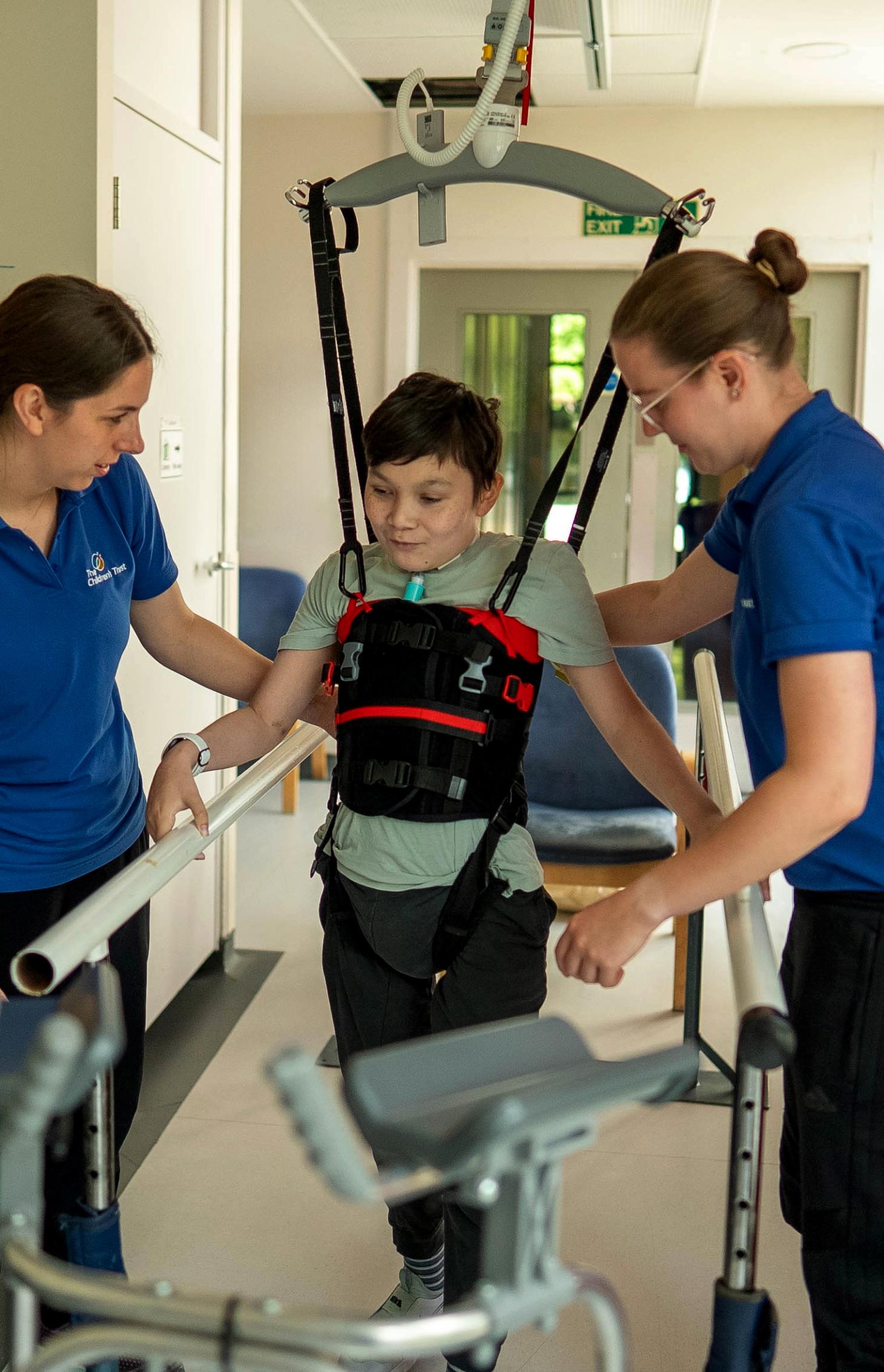
“When he was originally here, he needed full support just to be able to sit up,” explains Laura. “His chair was doing all the work to keep him upright. Now he's sitting himself up. He's bringing himself forwards. He changes his top half when he's sitting on the edge of the bed… and he's walking with a pulpit frame.”
“From an upper limb side of things, he didn't have any movement in any of his fingers on his left hand, his wrist or his elbow. And now, I described it today to the rest of the team as, ‘He's made a 100% increase in being able to grasp, release and use that hand with function.’”
Neurotechnology supports and speeds up Leo’s recovery
It has taken extraordinary hard work, patience and determination from Leo to get to where he is today. In order to restore movement after a brain injury, children have to work on repeating the same movements again and again, pushing through pain, fatigue and frustration.
Thankfully, at The Children’s Trust, Leo has had access to a range of neurotechnology that has encouraged this gentle repetition of movement in the most painless way – physically, mentally and emotionally.
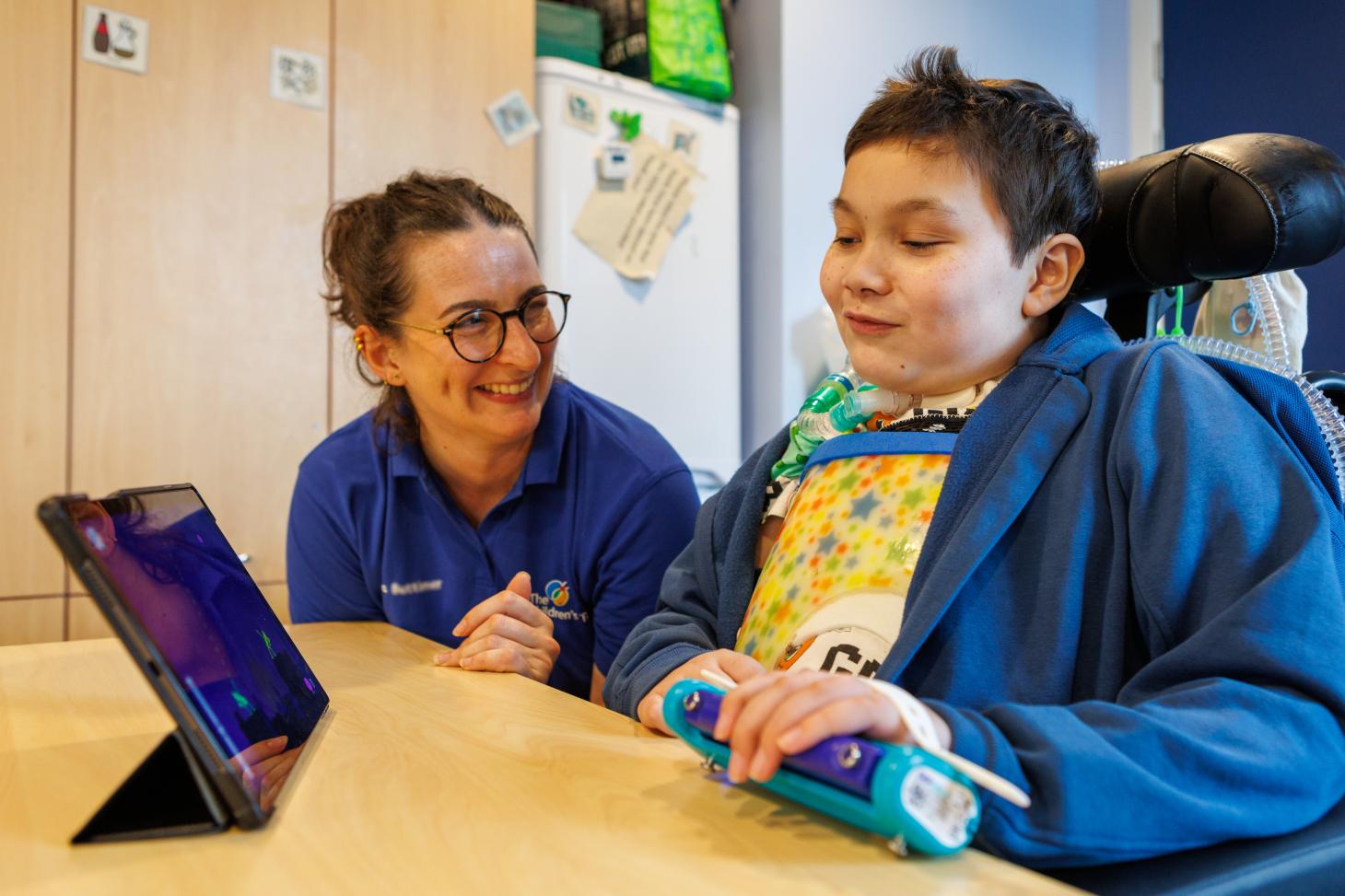
“Leo has probably used more of our kit than most kids here,” explains Laura. “He’s used the Diego, the Pablo, GripAble, and we did a bit of work on the Fesia. And in physiotherapy he’s done the Innowalk and used the Guldmann Hoist – that’s been instrumental from a physical development side of things, and also with his confidence.”
For children like Leo, this incredible technology doesn’t just offer physical support so that they can gradually build strength, it also makes the process more interesting, so that they can stick with it for longer.
The Diego, for example, supports the arm while a child watches and plays an interactive game on a screen in front of them. “It’s a motivating factor,” says Laura. “What we're really looking at is the reps and building on neuroplasticity after a brain injury. That’s where games are really useful, because they don't know that they're doing those reps – so it’s that distraction factor as well… Without them we’d see more difficulties getting them engaged.”
While it’s impossible to know where Leo’s recovery would be without the neurotechnology, Laura is certain he wouldn’t be where he is now. His progress slowed down considerably while he was at home in between his two placements at The Children’s Trust – indicating just how much of an impact it has.
Looking to the future
During the last month of his time at The Children’s Trust, one of his main goals was to keep strengthening his walk. He has come so far and his journey continues – but Laura believes he'll live independently one day.
“I honestly think that boy will work, he'll contribute to society, he'll go to university if he wants to go to university. What's really important is, I think he's beginning to see that he can.”
For Asuka, all of this feels incredible, given what he has been through. “He wants to be able to walk, but I’m grateful that he is alive actually,” she says. “He survived, he’s happy, and he’s him. It’s hard, but you just have to think how lucky we are to still have him.”
She is extremely grateful to The Children’s Trust for helping Leo make the progress he’s made and is certain there is nowhere better for his rehabilitation.
“What has The Children’s Trust given me? Hope. We've got to be here. I don't know anywhere else that can help him.”